+6016-2339966
- Introduction
- Active Protection
- Passive Protection
- Predicted Service Life
- Duplex Systems
- Re-Liquidising of Zinga
Zinga is a unique form of corrosion protection because it provides both Active and Passive protection in a form that’s as easy to apply as a paint…
BUT… Zinga is not a paint.
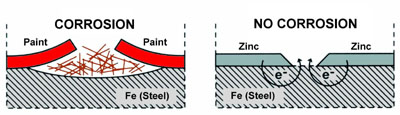
Zinga is an active zinc performance coating which works in conjunction with the metal beneath whereas paints are only passive barriers. Regardless of how thick paints are applied, they remain as barriers. Once they are breached corrosion sets in immediately. Despite this significant difference Zinga is still often mistaken for a paint simply because it’s liquid and comes in a tin. But there are other more subtle differences. For example it does not “skin over” in the tin because Zinga has an unlimited pot-life and it doesn’t go “tacky” like a paint.
Within Zinga though this sacrificial rate reduces dramatically after the zinc layer has oxidised and the natural porosity have been filled with zinc salts. Additionally the zinc particles within the Zinga layer are protected by the organic binder without adversely affecting the electrical conductivity. This enables Zinga to create nearly the same galvanic potential between the zinc and the steel as hot dip galvanising but with a lower rate of zinc loss because, put simply, the binder acts as a “corrosion inhibitor” to the zinc. Please see the Zinc Loss Prediction Chart further down this page for a estimate of expected zinc coating service life.
“The zinc in Zinga becomes the sacrificial anode in relation to the steel but it corrodes at a much slower rate than would otherwise be expected”
With Zinga, the organic binder and the zinc oxide layer that forms on the surface create an impervious barrier by blocking the zinc’s natural porosity with oxide particles. Unlike other passive coatings, once breached the zinc oxide layer simply renews itself by re-oxidising. This layer of oxides is the reason behind the matt appearance of Zinga as opposed to the shiny hot-dipped finish.

The corrosion rates of zinc in various environments have been well researched over the years. As a result it is possible to chart the predicted service life for a zinc layer at a given dry film thickness (DFT) in a particular situation. The chart below is based on Hot-Dip Galvanised steel but, as it has already been explained in the Active Protectionsection, Zinga performs at least as well as HDG in normal atmospheric conditions and even better in marine environments. Please note that the minimum acceptable DFT would normally be 50 microns i.e. the structure should be re-loaded with new Zinga once the zinc has depleted to 50um from its original DFT (normally >120um if using Zinga without topcoats). This is an important point as otherwise this chart could be misleading.